 AgentBlindfold
Let AI coding agents work — without seeing your secrets.
AgentBlindfold is a credential-flow control plane for agents like Claude Code and Codex. It launches the agent with a sanitized environment, brokers secrets only to approved commands, and keeps a tamper-evident audit trail.
cargo install agentblindfold
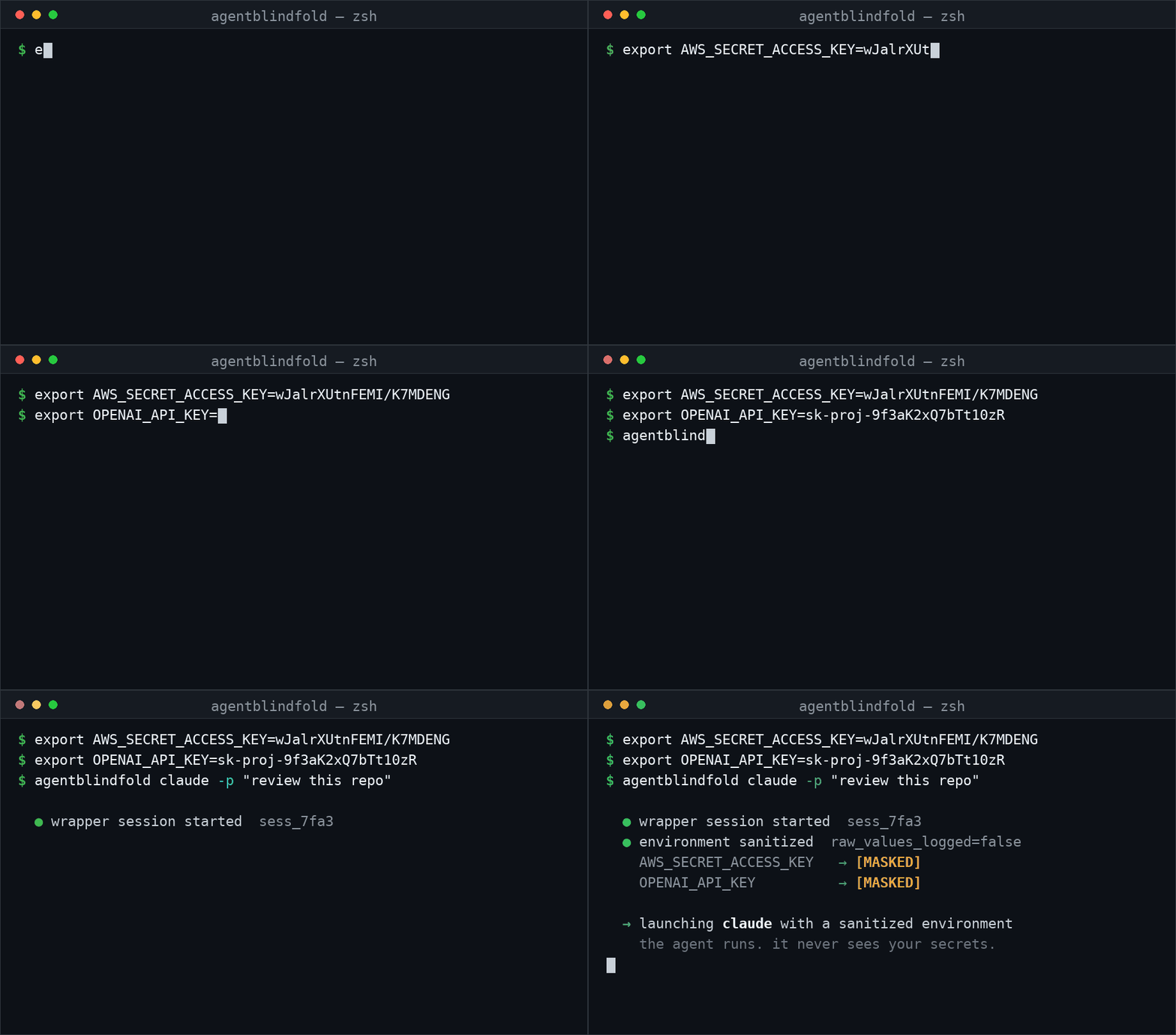
Agents inherit everything your shell knows
Environment variables, .env files, and command output are the easy paths for a secret to leak into a prompt, a log, or a model. AgentBlindfold puts a boundary in front of that flow.
Inherited secrets
A launched agent sees AWS_SECRET_ACCESS_KEY, provider keys, and every other exported variable — plus whatever your commands print.
Sanitize & mask
AgentBlindfold starts the agent with a sanitized environment and registers known secrets for output redaction as [MASKED:NAME].
Brokered release
Only commands that match an explicit execution profile receive scoped credentials — through the policy-gated exec broker.
Three moves: sanitize, broker, audit
Sanitize the launch
The wrapper (agentblindfold claude) starts the native agent with a cleaned environment — provider keys and AWS_* masked by default — while preserving the real TUI.
Broker the secrets
exec --profile is a policy gate: it releases vault secrets, reference-mode credentials, or short-lived materializations only to commands that match a profile's patterns.
Audit everything
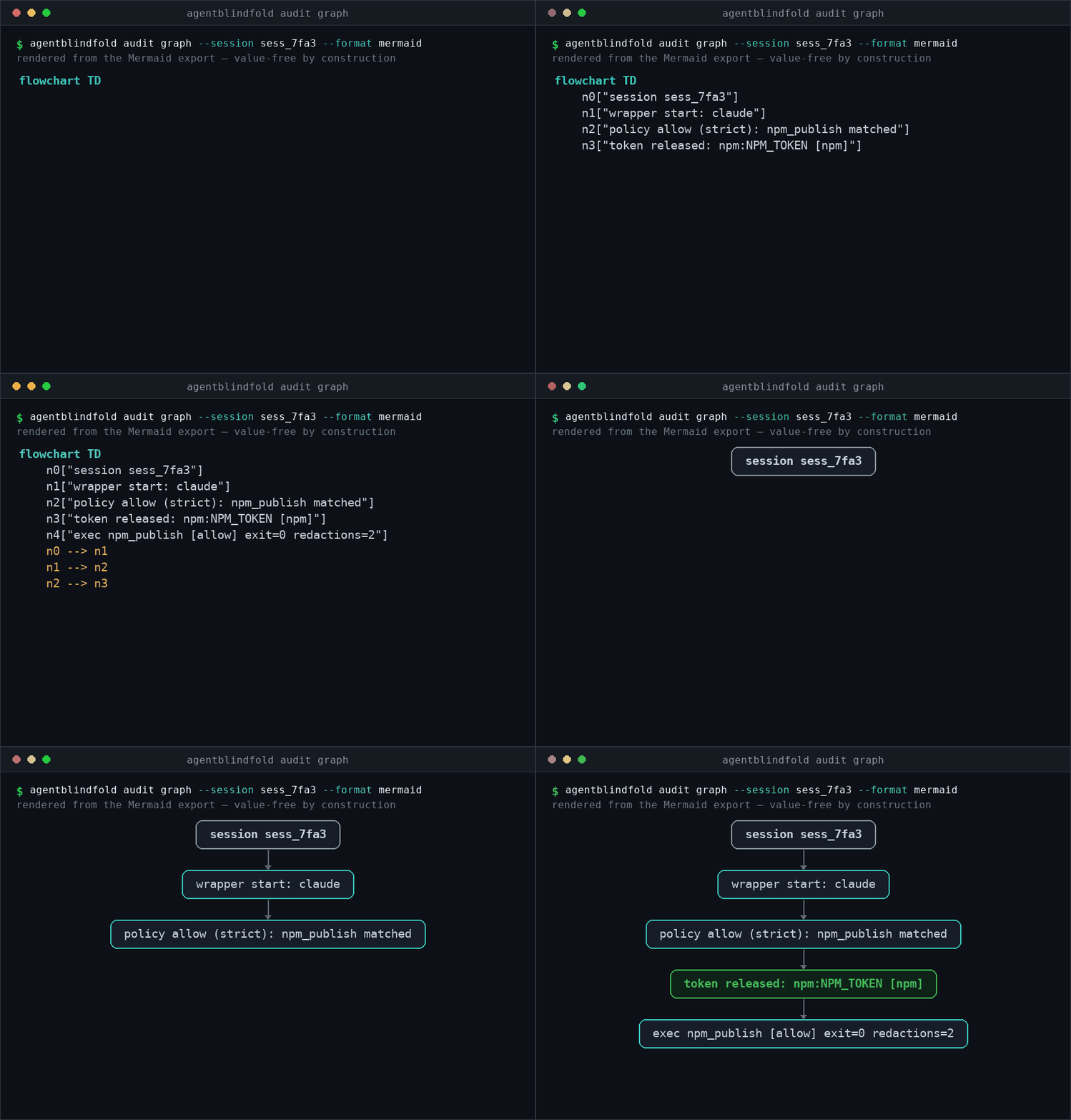
Every launch and decision writes a value-free, hash-chained JSONL event. audit verify proves the chain wasn't tampered with; audit graph exports a session flow.
A control plane, not just a wrapper
Sanitized environments
Launch Claude Code with inherited secrets stripped. Opt provider keys back in explicitly — they stay registered for redaction.
Policy-gated exec broker
Scoped execution profiles match commands by glob and release only the named vault, AWS-reference, or Kubernetes credentials they're allowed to.
Encrypted vault
Secrets at rest under AES-256-GCM with an Argon2id-derived key. Import from .env; list shows names and masked previews only.
Scanning & redaction
Shared pattern, context, and entropy detectors find secrets in the repo and mask them in captured output — even across stream boundaries.
Tamper-evident audit
Hash-chained events record names, decisions, and reasons — never values. audit graph exports Mermaid or DOT for a single session.
Native agent wrappers
TUI mode inherits stdio so the full-screen Claude Code experience is untouched. Arguments like -p pass through verbatim.
Keep the sandbox. Add a credential boundary.
AgentBlindfold is not a replacement for Claude Code, Codex, or OS-level sandboxing. It complements those controls, and the layers are designed to coexist.
Sandbox the runtime
Claude Code, Codex, and OS-level sandboxes constrain where code can operate through filesystem, network, process, permission, and approval boundaries.
Protect credential flow
AgentBlindfold sanitizes inherited secrets, releases approved credentials only to profile-matched commands, redacts brokered output, and records value-free audit events.
Use both layers
The sandbox limits the agent's operating boundary; AgentBlindfold limits its credential boundary. It preserves and, where configured, enables native sandbox controls rather than bypassing them.
Up and running in a minute
Run the setup wizard, then launch your agent through AgentBlindfold. The wizard only ever prints names, paths, and masked previews — never raw values.
# install from crates.io (latest release)
$ cargo install agentblindfold

# …or pin a version
$ cargo install agentblindfold@0.3.0

# …or build from a local checkout
$ cargo install --path .

# detect the project, scan safely, write config
$ agentblindfold setup

# launch the native agent, sanitized
$ agentblindfold claude
# which profile fits this command?
$ agentblindfold profile suggest \
    --command "python -m pytest"

# release only that profile's secrets
$ agentblindfold exec --profile test \
    -- python -m pytest

# prove the audit chain is intact
$ agentblindfold audit verify
Explicit behavior when something looks risky
Every decision carries a reason and can be audited. Resolution order: CLI flag → profile → execution default → policy default → strict.
| Mode | Behavior |
|---|---|
| strict | Blocks risky operations and exits non-zero. This is the default. |
| audit | Allows where possible, prints a warning, and records what strict mode would have blocked. |
| interactive | Asks before sensitive operations on a TTY; otherwise falls back to the fail behavior. |
| allow | Allows the operation while still redacting known secrets and auditing risky behavior. |
Every decision recorded — no values, tamper-evident
When enabled, safe JSONL events land in .agentblindfold/audit.jsonl. Each new event is hash-chained over canonical, value-free JSON, so audit verify catches any modified, deleted, or reordered entry.
- Value-free by construction. Names, decisions, reasons, exit codes, and redaction counts — never secret values.
- Tamper-evident.
previous_hash/event_hashlink the chain;audit verifyfails loudly if it breaks. - Defensive rendering. The viewer re-runs every line through the redactor, so even a legacy hand-written value stays masked.
- Graph export.
audit graphemits Mermaid or Graphviz DOT for one session — export only, no rendering deps, safe references likenpm:NPM_TOKENand explicitNO TOKEN RELEASEDnodes.
$ agentblindfold audit summary
$ agentblindfold audit tail --lines 20
$ agentblindfold audit verify
$ agentblindfold audit graph --session sess_7fa3 \
    --format mermaid
Clear about what it is — and isn't
AgentBlindfold reduces accidental secret exposure. It is not an OS sandbox or a replacement for Claude Code or Codex sandboxing. Use these complementary layers together.
What it does
- Starts agents with sanitized environments
- Redacts known secrets from captured output
- Brokers credential release through approved profiles only
- Encrypts the vault and prints names, never values
- Writes a tamper-evident, value-free audit log
What it does not
- Prevent all file reads on the machine
- Prevent all network access or egress
- MITM or inspect HTTPS requests
- Replace Claude Code or Codex permissions and sandboxing
- Guarantee a malicious child can't reach other OS channels
🛡️ Built by a husband-and-wife engineering team
“AgentBlindfold started with one question: Can AI agents help without seeing what they should not?”
We are building it under AgentDefSec Labs to make AI-assisted development safer, more practical, and a little less scary.
Give your agent a blindfold before you give it your repo
Install, run agentblindfold setup, and launch your agent the way you already do.